

LED Work Lights Market Poised for Steady Growth as Demand for Safer, Energy-Efficient Jobsite Lighting Rises
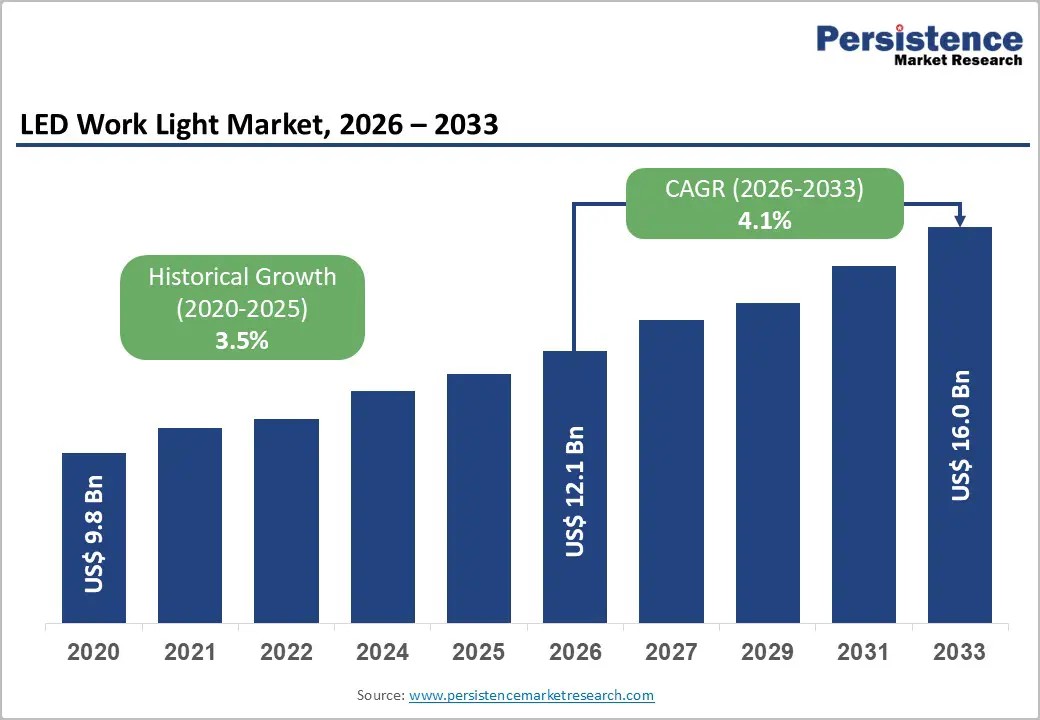
The global LED work light market is set to grow from US$12.1 billion in 2026 to US$16.0 billion by 2033, registering a 4.1% CAGR during forecast period
BRENTFORD, ENGLAND, UNITED KINGDOM, January 26, 2026 /EINPresswire.com/ -- The LED Work Light Market has evolved into a critical component of modern industrial and commercial lighting, driven by the need for reliable, energy-efficient, and high-performance illumination. LED work lights are widely used across construction sites, manufacturing plants, warehouses, mining operations, and automotive workshops where consistent visibility directly impacts productivity and worker safety. Compared to traditional halogen or incandescent lights, LED work lights offer superior brightness, longer lifespans, and significantly lower energy consumption, making them the preferred choice across professional environments.
From a market perspective, the global LED work light market size is projected to reach US$ 12.1 billion in 2026 and further expand to US$ 16.0 billion by 2033, registering a CAGR of 4.1% during the forecast period from 2026 to 2033. Growth is underpinned by rising industrial activity, stricter safety regulations, and the accelerating shift toward cordless and battery-operated lighting solutions. Industries are increasingly prioritizing durable, weather-resistant, and explosion-proof lighting to comply with workplace safety norms while improving operational efficiency.
𝐆𝐞𝐭 𝐚 𝐒𝐚𝐦𝐩𝐥𝐞 𝐏𝐃𝐅 𝐁𝐫𝐨𝐜𝐡𝐮𝐫𝐞 𝐨𝐟 𝐭𝐡𝐞 𝐑𝐞𝐩𝐨𝐫𝐭: https://www.persistencemarketresearch.com/samples/13960
Market Statistics, Growth Drivers, and Leading Trends
A key growth driver in the LED work light market is the global push for energy efficiency and sustainability. Governments across North America and Europe have introduced stringent energy standards, such as U.S. DOE regulations and EU eco-design directives, encouraging the adoption of LED-based lighting systems. At the same time, industries are replacing legacy lighting to reduce maintenance costs and downtime, as LED work lights offer longer operational life and consistent lumen output.
The battery-operated LED work light segment leads the market with a dominant 62% share, owing to its portability, cordless convenience, and compatibility with lithium-ion power tool batteries. Brands such as Milwaukee and DeWalt have successfully expanded cordless ecosystems, allowing users to interchange batteries across tools and lighting equipment. Geographically, North America leads the market, accounting for around 35% of global revenue in 2026, driven by strict OSHA safety regulations and high adoption of professional-grade tools. Meanwhile, Asia Pacific is emerging as the fastest-growing region, fueled by infrastructure expansion, industrialization, and increasing awareness of energy-efficient lighting.
LED Work Light Market Segmentation Analysis
The LED work light market is segmented by product type, including battery-operated, plug-in electric, and hybrid LED work lights. Battery-operated models dominate due to their cordless flexibility and compatibility with modern lithium-ion tool systems. Plug-in LED work lights continue to be used in fixed industrial settings where continuous power supply is available, while hybrid models are gaining traction for their dual-power capability, offering reliability in diverse work conditions.
By end-user, the market is segmented into industrial, construction, automotive, mining, and commercial applications. The industrial segment leads the market, accounting for nearly 45% of revenue, driven by automation, 24/7 operations, and the need for high-lumen, hazardous-location-compliant lighting. Construction and automotive workshops also represent significant demand, particularly for portable and rugged LED work lights that can withstand harsh environments and frequent movement.
Regional Insights and Market Dynamics
From a regional standpoint, North America remains the largest market for LED work lights, supported by high labor safety standards, advanced construction practices, and strong purchasing power among professional contractors. The widespread adoption of cordless tools and lighting ecosystems further strengthens demand across the U.S. and Canada, particularly in industrial maintenance and large-scale construction projects.
In contrast, the Asia Pacific LED work light market is witnessing rapid growth due to accelerating industrialization in China, India, and Southeast Asia. Massive investments in infrastructure, mining, and manufacturing are boosting demand for durable and energy-efficient lighting solutions. Europe also shows steady growth, driven by sustainability mandates and the modernization of industrial facilities across Germany, France, and the Nordic countries.
𝐃𝐨 𝐘𝐨𝐮 𝐇𝐚𝐯𝐞 𝐀𝐧𝐲 𝐐𝐮𝐞𝐫𝐲 𝐎𝐫 𝐒𝐩𝐞𝐜𝐢𝐟𝐢𝐜 𝐑𝐞𝐪𝐮𝐢𝐫𝐞𝐦𝐞𝐧𝐭? 𝐑𝐞𝐪𝐮𝐞𝐬𝐭 𝐂𝐮𝐬𝐭𝐨𝐦𝐢𝐳𝐚𝐭𝐢𝐨𝐧 𝐨𝐟 𝐑𝐞𝐩𝐨𝐫𝐭: https://www.persistencemarketresearch.com/request-customization/13960
Market Drivers Fueling Growth
One of the primary market drivers is the increasing emphasis on worker safety and compliance. LED work lights provide high-intensity, flicker-free illumination that reduces accidents and eye strain in hazardous environments. Additionally, the superior durability and shock resistance of LED lights make them suitable for demanding industrial applications.
Another significant driver is the rapid adoption of cordless and battery-powered solutions. Professionals increasingly prefer portable LED work lights that integrate seamlessly with existing power tool batteries, enhancing convenience and reducing equipment redundancy. This trend aligns with broader shifts toward mobile, flexible worksite solutions.
Market Restraints Limiting Expansion
Despite strong growth prospects, the LED work light market faces certain restraints, particularly related to high initial costs. Advanced LED work lights with explosion-proof housings, smart controls, or IoT features often come at a premium price, which may deter small contractors or price-sensitive buyers in developing regions.
Additionally, the market faces challenges from intense competition and product commoditization. As LED technology matures, differentiation becomes difficult, leading to pricing pressure and thinner margins for manufacturers. This makes innovation and branding critical for sustaining long-term profitability.
Emerging Market Opportunities
The integration of IoT-enabled smart LED work lights presents a major opportunity for market players. Features such as remote monitoring, predictive maintenance alerts, and asset tracking can significantly enhance value for industrial customers managing large fleets of lighting equipment.
Another promising opportunity lies in hazardous and explosion-proof lighting solutions. As industries such as oil & gas, chemicals, and mining expand operations, demand for certified LED work lights designed for hazardous locations is expected to rise, creating high-margin growth avenues for specialized manufacturers.
Company Insights and Competitive Landscape
Key players operating in the global LED work light market include:
Milwaukee Tool
DeWalt (Stanley Black & Decker)
Bosch
Emerson Electric
Larson Electronics
Streamlight
Signify (Philips Lighting)
Eaton Corporation
𝐁𝐮𝐲 𝐍𝐨𝐰 𝐭𝐡𝐞 𝐃𝐞𝐭𝐚𝐢𝐥𝐞𝐝 𝐑𝐞𝐩𝐨𝐫𝐭: https://www.persistencemarketresearch.com/checkout/13960
Recent Developments:
In 2024, Milwaukee expanded its cordless LED work light portfolio with high-lumen models compatible with its M18 battery platform, targeting industrial professionals.
In 2025, Signify introduced smart-connected LED work lights with remote monitoring features for large industrial facilities, strengthening its presence in the premium segment.
Related Reports:
Materials Management Information System (MMIS) Market
Pooja Gawai
Persistence Market Research
+1 646-878-6329
email us here
Visit us on social media:
LinkedIn
Instagram
Facebook
YouTube
Legal Disclaimer:
EIN Presswire provides this news content "as is" without warranty of any kind. We do not accept any responsibility or liability for the accuracy, content, images, videos, licenses, completeness, legality, or reliability of the information contained in this article. If you have any complaints or copyright issues related to this article, kindly contact the author above.
